Hey, have you ever thought about how tough it is to dig tunnels right under a bustling city? On one side, you’ve got hard rock; on the other, there are buildings packed with people. If you dare to use explosives and go "boom," you can bet the complaint hotline is going to blow up.
For a long time, engineers were really stuck between a rock and a hard place. They either had to spend a fortune on massive Tunnel Boring Machines (TBMs) or bite the bullet and use explosives, worrying constantly about the risks. But now, there’s a new player in town called CO2 Gas Fracturing Technology, and it offers a genuine third way out.
Why the Old Ways Just Don’t Cut It
Think about it: the shockwaves from traditional explosives don’t just stop at the excavation line. They travel outward, shaking the walls of nearby buildings. Data shows that blasting often pushes vibration levels way past safety limits, annoying residents hundreds of meters away.
But this CO2 tech? It’s a game-changer. Field data shows that at a distance of 30 meters, the vibration velocity is only 0.18 cm/s—that’s just 18% of the standard safety limit! What does that mean? People living in the buildings above can’t feel a thing, and the structure stays perfectly safe.
Plus, explosives are loud! Even underground, the bang can rattle windows for blocks. Many cities have strict rules against blasting near homes, which squeezes working hours down to just 6-8 hours a day. And the paperwork? Don’t even get me started. You need permits from all over the place just to store and use explosives.
How This New Tech Works
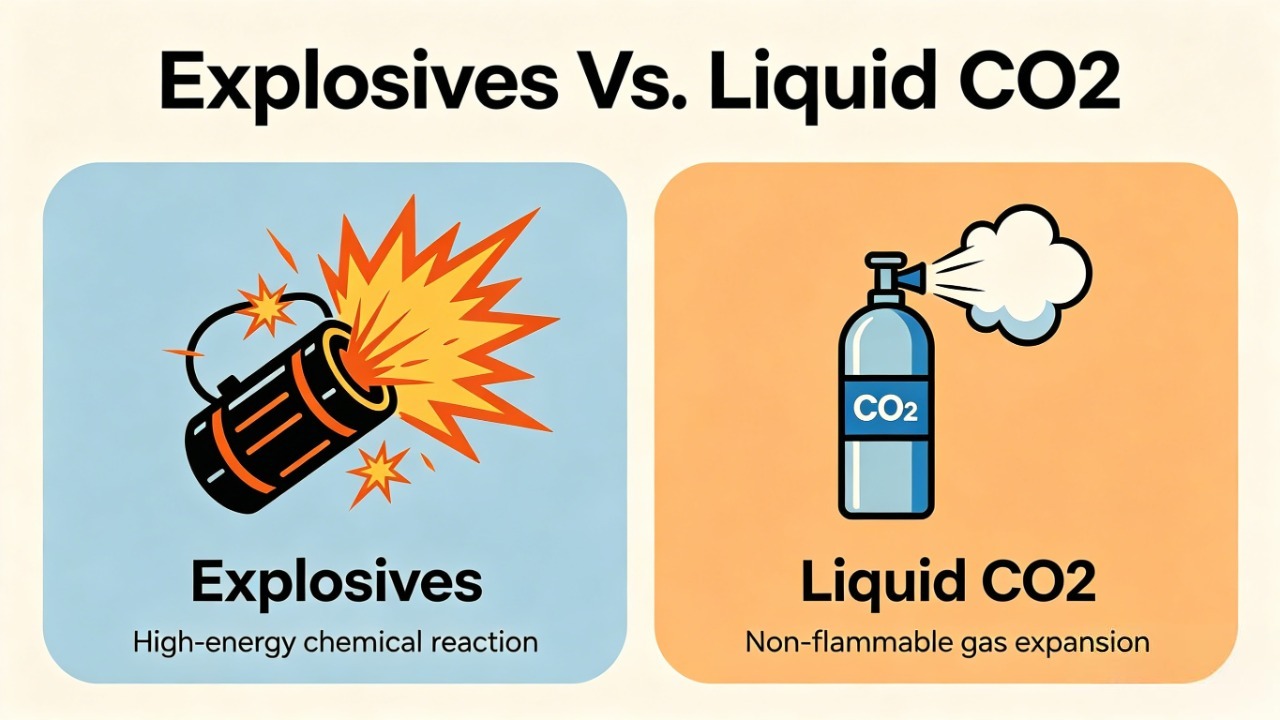
Simply put, it uses the rapid expansion of liquid carbon dioxide turning into gas to crack the rock. It’s a physical process, not a chemical explosion. No fire, no toxic fumes.
For the crew on site, the benefits are huge:
- Safe Vibration: Well below regulatory limits.
- No Flyrock: Debris stays within about 5 meters. No need for massive exclusion zones.
- No Toxic Fumes: Workers can get back to the face within minutes(open-air environment). No waiting around for ventilation.
- No Explosives Storage: You don’t need a magazine on site, which simplifies security big time.
- 24/7 Operations: Because it’s quieter and safer, you can often work around the clock.
Where Does It Shine?
This tech is practically made for cities.
- Metro Lines: In dense urban cores where TBMs are too expensive for short runs and blasting is banned.
- Road Tunnels: Near villages, monasteries, or archaeological sites where you can’t risk vibration damage.
- Utility Tunnels: Right under people’s feet, where you need to keep surface disturbance to a minimum.
How Does It Compare?
Let’s look at the numbers. When you stack it up against other methods, CO2 fracturing hits the sweet spot for urban projects.
| Method | Advance Rate | Capital Cost | Vibration Level | Suited For |
|---|---|---|---|---|
| CO2 Gas Fracturing | Medium-High | Low | Very Low (0.18 cm/s) | Most rock types, urban, underground |
| TBM (Tunnel Boring Machine) | High (uniform rock) | Very High | Low | Long tunnels, consistent geology |
| Roadheader (Mechanical) | Medium | Medium-High | Low | Soft-medium rock only |
| Static Expansive Agent | Very Low | Low | Very Low | Small volume, soft formations |
| Conventional Blasting | High | Low-Medium | Very High (2.61 cm/s) | Remote sites, non-urban |
The Bottom Line
Urban tunneling used to be a nightmare of compromises. But with CO2 gas fracturing, you can get the job done efficiently without shaking the neighbors or drowning in paperwork. If you’ve got a project that needs rock breaking with minimal fuss, it’s definitely worth a look. Why not give the team a shout for a free assessment?